
As I stepped on the tour boat, I got out my copy of the book. I was the only tourist with a book, at least one that didn’t have restaurant recommendations in it. I’d orchestrated a few days off after my meetings in Osaka because of a paragraph:
Much praise had already been lavished upon the wonders of the islands of Matsushima. Yet if further praise is possible, I would like to say that here is the most beautiful spot in the whole country of Japan, and that the beauty of these islands is not in the least inferior to the beauty of Lake Dōtei or Lake Seiko in China. The islands are situated in a bay about three miles wide in every direction and open to the sea through a narrow mouth on the south-east side. Just as the River Sekkō in China is made full at each swell of the tide, so is this bay filled with the brimming water of the ocean, and innumerable islands are scattered over it from one end to the other. Tall islands point to the sky and level ones prostrate themselves before the surges of water. Islands are piled above islands, and islands are joined to islands, so that they look exactly like parents caressing their children or walking with them arm in arm. The pines are of the freshest green, and their branches are curved in exquisite lines, bent by the wind constantly blowing through them. Indeed, the beauty of the entire scene can only be compared to the most divinely endowed of feminine countenances, for who else could have created such beauty but the great god of nature himself? My pen strove in vain to equal this superb creation of divine artifice (from Nobuyuki Yuasa, trans., Matsuo Bashō, The Narrow Road of the Deep North and Other Travel Sketches. Penguin Classics [1966], pp 115-116).

Fan-girl on the lake
I love Bashō’s Narrow Road of the Deep North (alternately, The Narrow Road of the Interior). It’s the perfect expression of the experience of travel, from the backroads of seventeenth century Japan. Bashō sets out with high hopes, takes in some history, gets tired, gets fussy, comes upon unexpected moments of beauty. He makes some new friends, uses the imperative of the road to ditch new acquaintances he doesn’t care for, has some good nights’ rest and a few bad, all recorded in a blend of conversational prose and crisp, evocative haiku. My favorite is the 17th century equivalent of a one-star hotel review: “Fleas and lice/and by my pillow/a pissing horse.” I specifically remember this version with the horsey evacuation as its blunt conclusion, although I can no longer locate this specific translation; Yuasa’s and the others that I have to hand put the horse in the middle, which feels less satisfying, even if it might more accurately represent the original structure of the poem. Thankfully, there were no fleas or lice in my lodgings in nearby Sendai, although I did discover how popular Halloween had become with Japanese youth, who thronged the downtown area dressed in various combinations of zombie and kawaii.
So here I was taking in this stop on Bashō’s route with my ready reference copy of his travelogue. It was a crisp blue day, chilly but not chilling, and no rain threatening on the horizon. He didn’t get to see the lake by boat, but I was not going to miss that opportunity. The lake has more than two hundred tiny islands on it, and I was drawn to Bashō’s description because his islands were alive: unfolding and caressing, animate landscape, stilled in a posture of gentle preening. I was not disappointed. One set of islands rippled across the lake surface, culminating in the outstretched arm of a pine gesturing towards the blue distance. Another loomed, solitary and stoic. A sea-dragon reared above the water’s surface. A shy figure crouched between parted curtains. I posed for a selfie, my scarf rippling into the blue air.
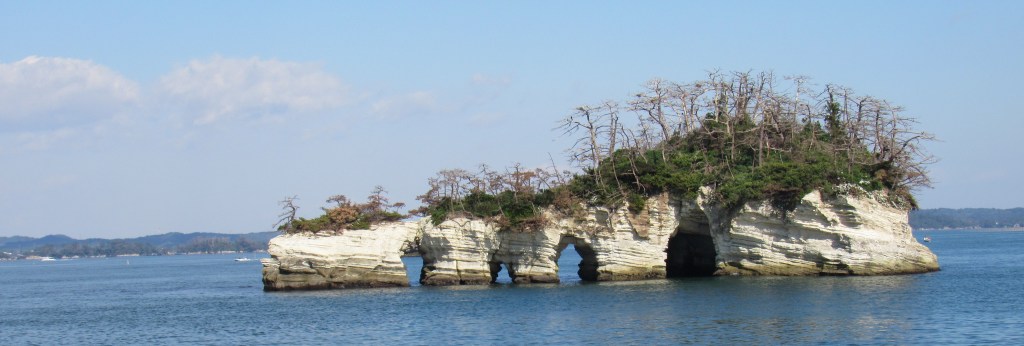
After the boat tour, I followed the walking paths around the lake; more in the spirit of Bashō’s 1500 mile walking journey to take things in on foot. Here were natural alcoves to peer through the branches that reached over the water. To see the shift of perspective at the speed of a footstep is different from even the leisurely pace of a tourist boat. At a walking tempo, the quiet settled around me, Islands drifted slowly into new patterns, one timidly peeking from behind another before settling into its own solidity. The paths around the lake weren’t crowded: I was one of a company of wanderers, but we didn’t impose on one another, and the trail through the pines surrounding the lake, while not empty, felt full with stillness.

Strung across a space in the canopy were thick webs, hung with showy spiders, three or four inches across. Scanning through my photos, I realize now that these are the same spiders who started to make their home in my Georgia yard a few years ago: Trichonephila clavate, the Joro spider, native to Japan but a recent addition to the Southern landscape. When I glimpsed them around Matsushima, I was drawn to their novelty, their brilliant yellow patterning, the way they hung across the view: there they sat, suspended between Bashō’s artistic pines, exotic fauna I hadn’t expected to find or to find beautiful. Now, each autumn, I encounter them weaving fortresses above my garden, a few more each year. Technically, they’re an invasive species, a potential threat to natives, like the yellow orb weaver, a favorite from my childhood with its thick, striped body and signature zigzag web. But I’ve come to love the Joros. They’re lovely (and apparently shy). And they’re hardy: whatever storms blow through, their thatch of webs remain, an intricate, symmetrical center sheet, supported by haphazard outer layers, what looks like a kludge of redundant strands encasing the more refined center, harnessed to the frothy tops of goldenrod and anchored in the overhanging dogwood. Strange that an unexpected sidelight of my literary pilgrimage on the other side of the world has itself become a traveler and is now a cohabitant of my daily life.
I know I wasn’t looking at the same islands Bashō visited: certainly, it was the same lake, but wind and water had had more than three hundred years to alter their design by the time I arrived. The “tuff” that is the main component of each island — a combination of sandstone and volcanic ash — was itself in motion, an “eternal traveler” like the sun and moon, to use a phrase from the opening of Sam Hammil’s 1998 translation. On one squat spire of an island, green sandbags that had certainly not been there in Bashō’s time had been arranged around the base of the solitary pine that occupied the summit, an effort to keep the tree in place by preventing the soil from washing away. My expedition was both a reenactment of one small part of someone else’s journey and a new discovery, an homage to the past and, to borrow Bashō’s phrase (via Hamill), evidence that “every day is a journey, and the journey itself is home” (The Narrow Road of the Interior, Shambhala Publications, 1998). After all, in the end, I didn’t spend much time refering to my book that day. I was too busy taking the place in.
 In the Bee-Loud Glade