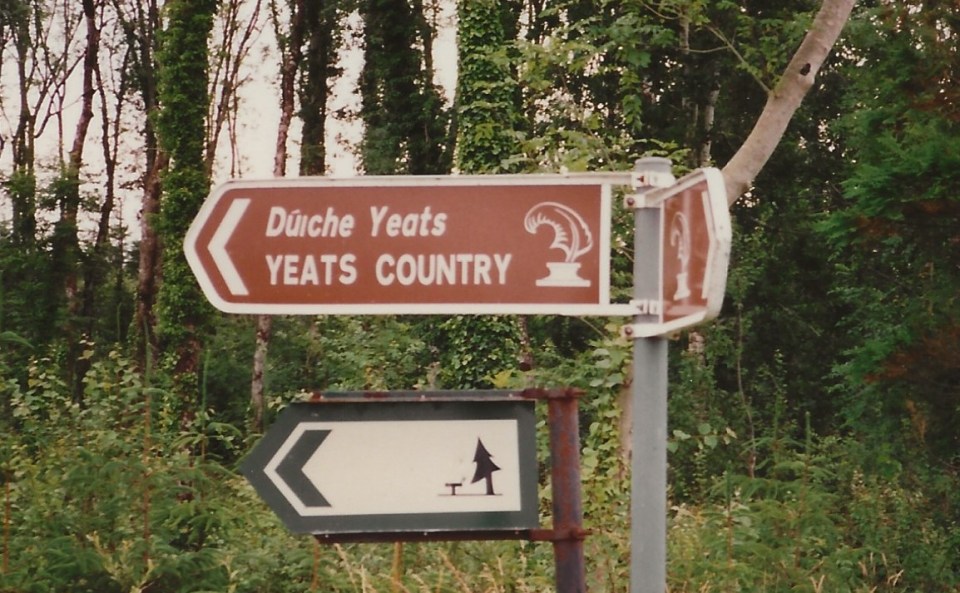
I went to Yeats Country when I was twenty-two, brimming with infatuation for all things Irish and poetic; while I failed to bring more than one substantial piece of outerwear, I had volumes of Kavanagh and Heaney stuffed in my school-sized backpack, the only luggage I’d brought. I was there to see the places from the poems, to stand on the ground where inspiration had hit to see if I could understand the poems better by feeling the spirit of those surroundings.
In the way of a still novice traveler who had assumed that because summer was hot in the northern U.S., it would be hot in Ireland, I failed to check a map when I arrived in Sligo and spotted a sign directing me to “Yeats Country.” Eager to get on with experiencing things, I thus failed to realize that the sign indicated not a one-stop destination for all things W.B. but a lengthy loop around the city and its environs. Off I went on foot, a giddy bounce in my step, reciting to myself, “I will arise and go now.”
Although the memory of the walk is hazy now, I am fairly sure the weather held, temperate and sunny. My photo album is my map: I compiled it as soon as my blurry, poorly lit prints came back from whatever pharmacy I’d entrusted them to. First, an image of the countryside near Knocknarea, a low, mottled wall backed by squat green mountains. I found a sculpture garden in the middle of the woods. One of my better photos from the day is of a thick, heavy-booted wooden figure triumphantly holding a fish above his head, as if he wanted the trees to acknowledge his singular catch. And then there was the lake, and there was Innisfree.
I had no idea how small it would be or how densely wooded. I wondered where exactly the clay and wattle cabin might have fit, let alone the nine bean-rows. It was well past noon (did I miss the purple glow?), and I had no intention of waiting till midnight for the glimmer, but the promised low sounds of the lake water were true and pleasant. I don’t remember finding it an extraordinary place, but what mattered was that I was there, in the woods, by Lough Gill. Language and landscape had met.
I didn’t make it through all of Yeats Country that day. After what seemed like several hours of walking, I realized my error and, limping slightly, attracted the attention of a local who offered me a ride back to the city center. Exhaustion and hunger won out over every motherly injunction against taking rides from strangers; the statue of the Virgin Mary on the dashboard and the tow-headed toddler in the back offered added reassurance. My rescuer chatted happily to me about poetry on the way back into town, a cultural experience I marveled at, since conversations with strangers back home rarely crossed into such territory. I offer a belated thank you to that man, both for saving me from my own heedless enthusiasm and for not being what I’d feared.
Decades on, I remain fascinated by the connections between writing and place, and the way exploring landscapes creates a bloom of connection between the past and the page.
 In the Bee-Loud Glade